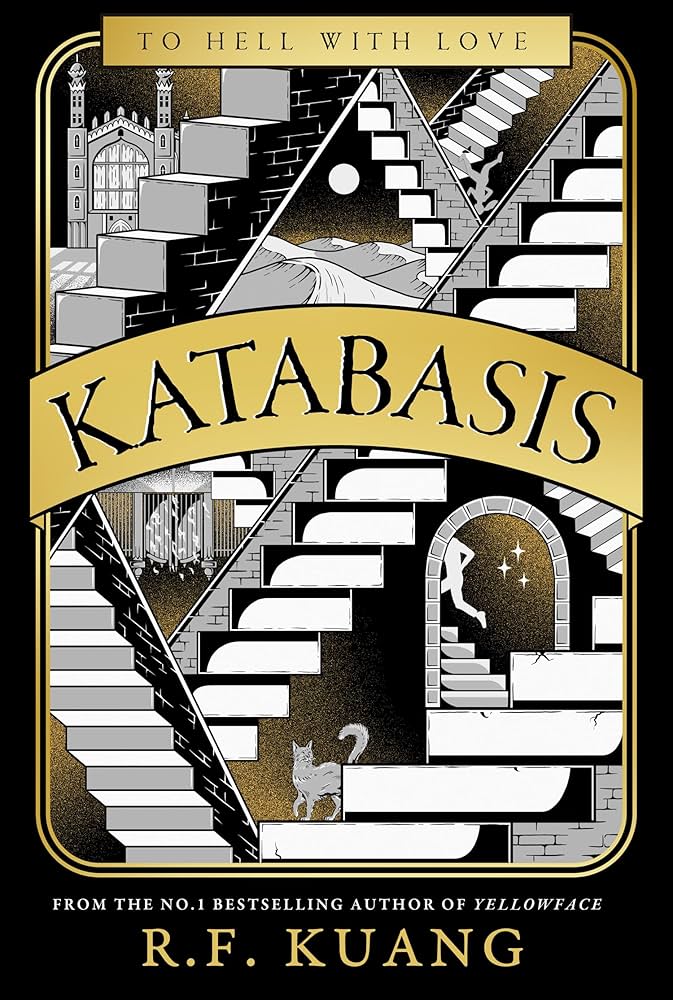
As a pretentious douchebag turning into an old man, I often (sometimes daily) come across various things I love to label as “concerning”. The one that got to me the most recently was the alarming direction of considering R.F. Kuang’s “Katabasis” as “too academic”. Reviewes on Goodreads – something I never recommend scrolling through – abound with strong dislike for the intellectual or academic “info dumps” (as they are being called). This is inherently an anti-intellectual position. People have wrongly subscribed to Cehov’s gun theory for far too long and it shows here in the number of people who complain about the novel’s narrative. We want all the exposition to exist for the single purpose of moving the plot forward because we are so used to “film type” books with all action and no ideas.
One of the reasons “Lord of the Rings” reads so very different than anything the contemporary Fantasy Industrial Complex puts out is because, as someone brilliantly remarked, is that Tolkien is not a prisoner of his own story. He spends so much time on Tom Bombadil – a character inconsequential to Frodo’s quest, as can be deduced from how easily he was cut from the movies – because Tom Bombadil is there. He is part of Middle Earth. That’s just how that world is. Turning every dialogue line, character, and observation into a narrative device hurts the worldbuilding. This industrial obsession that everything has to serve a (narrative) purpose makes us intellectually and spiritually poorer. I smiled when I heard Cameron answer “because I want to see it” when posed with the question of why he spent so much time with scenes of Pandora that are purely aesthetic and don’t help the story.
Many contemporary readers are, unfortunately, not versed in the classics and not used to real, incoherent stream of consciusness techniques. Disliking the “lecture” aspect of “Katabasis”, as one reviewer put it, only reinforces the idea that they want to read nothing but movie scripts. People reference their TikToks (a platform where we engage with a piece of content for at most 3 seconds, making it perfect for discussing ideas) in the written reviewes they leave on the site. This is telling in very many ways. Besides upsetting us by contradicting the law of Cehov’s gun, ideas just stand in way of our true desire: the storrytelling; this capitalist, entertainment market commodity, perfectly packaged in reductionist tropes and put in book form.
(P.S.: At the time of drafting this short text, I am 360 pages into the novel. I expected something along Joyce’s “A Portrait of the Artist as a Young Man”. Couldn’t be further.)
 The Hermeneutic Herald
Leave a comment