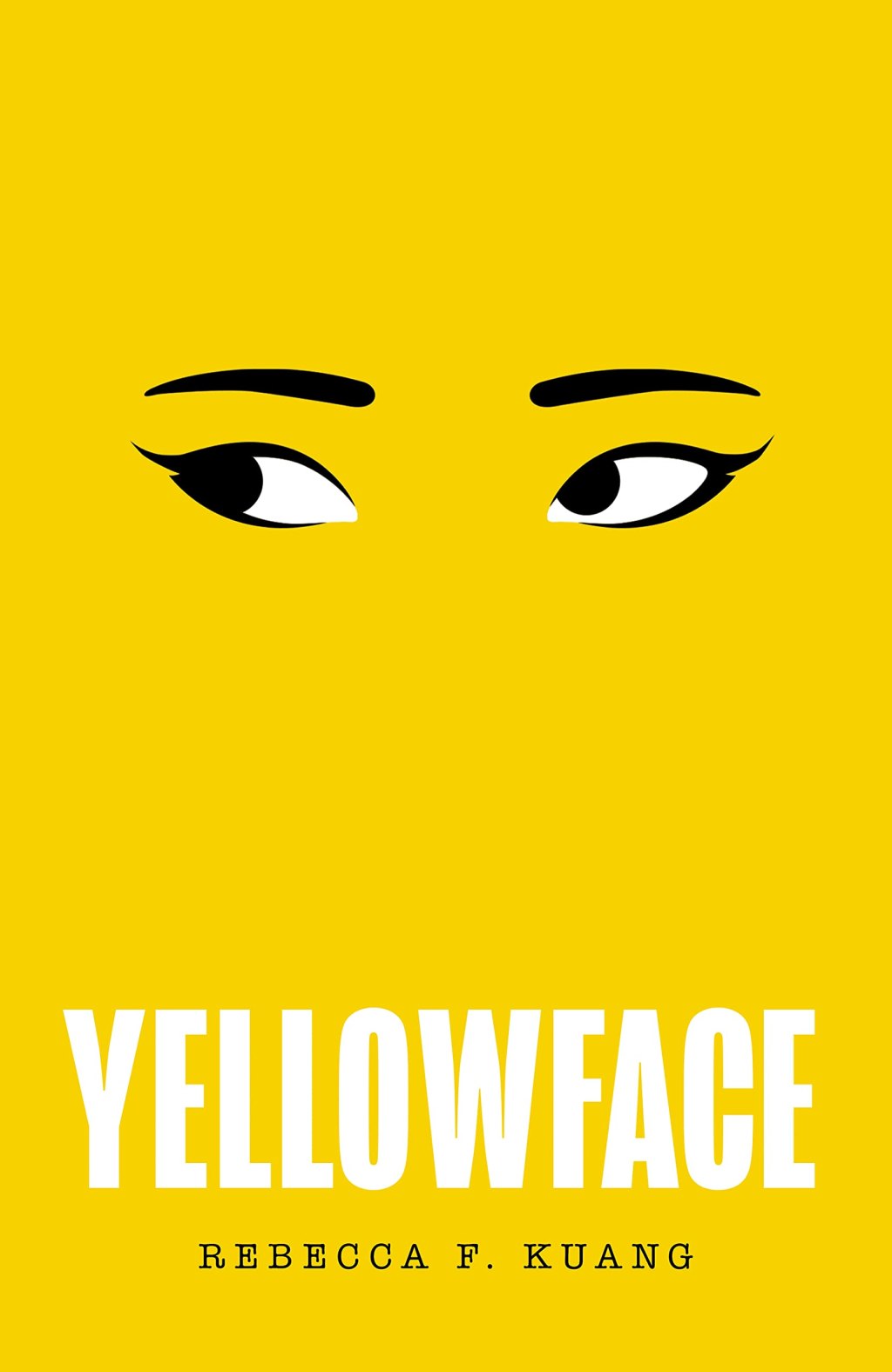
It’s less satire than some readers might be comfortable with and I have to join the choir of voice claiming they don’t believe the satire wil be properly parsed, if at all. “Yellowface” is mainly the intertwining of three planes, comprising three different perseptive dimensions: Athena (through June’s vision), June, and the “mob”, the Twitterati, the caricature of contemporary culture. Let’s start with that last one:
The Twitterati “mob”, representing the culture around books and publishing is perhaps the aspect of “Yellowface” that creates the most unease if one expects Kuang to exaggerate views of “woke” culture with the aim of defending it. She does a really great job at painting a biting critique of “woke” intellectualism through this collective pseudo-persona of the online mob. Now we all agree that it is always popular to hate on popular things, as June observes, so why would she even bother? This is something which might be difficult to accept for someone who is not a part of the digital-native generations, but social media is “realer than real life” – an excellent observation on June’s part. One cannot simply extricate one’s self from the online world in a paradigm in which the real world serves simply as a background for artsy Instagram pictures. What happenes in the digital space gains more weight proportionally to the amount of time we spent glued to our phones. In a globalized market of instantly-distributable ebooks written by millions of diferent voices, June needs attention in order to sell, to stay relevant, to be heard, and to ensure that she will be able to sign her next contract. Repeat in a loop.
The idea that sensitivity readers exist in real-life (a thing I had to Google out of disbelief) is inherently wrong. This soft censorship that the “woke” culture perpetuates highlights its complete lack of understanding in all things art and fictional – interestingly, exactly in the same way that people who are too far right don’t understand them either. June questions this very idea herself: “consanguinity doesn’t translate into unique epistemological insight”. One can see this again when June is asked by someone what narrative fiction can do for the underrepresented groups. Again, this si a profound misunderstanding of art’s dimensions (which the “woke” mob will always reduce to solely the political). These people exist and see everything through a singular lens. Of course we can – and should never try to – do away with art’s political dimension. However, this reductionism is the very essence of an idelological stance: not a critical or an aesthetic one. In the novel (as in real life), people are dissecting “problematic” lines from books. June enjoys this when it does not happen to her. Indeed, she correctly identifies in the next page that this is a mechanism through which these people create moral authority for themselves. Authority is, of course, as we all know, a great nurturing force for artistic expression. Thus, from the desire to use the newly created authority, “cancel culture” is born. June offers an interesting, telling example of the kind of statement that might get someone in trouble: “the classics are better” – it’s funny that in their embrace of tearing down anything (real or perceived) elitist they are copulating with inherently anti-intellectual positions. June briefly considers not exposing herself as “bait” […] “for further controversy”. Everything is a potential trap. But, as we will see, she also never realises her own shortcomings. The “mob” functions as a de-facto Ministry of Truth: always authoritarian, but always contradicting itself. Always rewriting, changing, confusing, but demanding your utter devotion. The psychological and physical illness we see June go through due to living within this toxic vortex is, perhaps, a nod to the idea that we are simply not meant to live in this digital world of so many voices and no consensus.
June’s perception of Athena is that she’s a quite pretentious young lady. Kuang leaves a passage about Athena that is very telling for some of the future reception “Katabasis” will have: Athena believed that the reader should move closer to the text, not the other way around. She also “steals” from others. Not in the proper sense, but she gives voice to stories that are not hers. This comes to the question: who has the right to tell which story? A Ministry of Truth would be able to determine the answer! The second you start trying to answer, you submerge yourself in authoritarian logic. Athena, in June’s view, was rich and never experienced suffering herself. This idea serves a dual purpose: it functions as a justification mechanism for her, but also introduces the concept of “a spectacle of pain”. Once it has been turned into art, the pain, as the novel tells, remains there. This is a powerful observation, for it begs the question: is awareness and having a voice enough? I will step into the trap of approximating an answer. The “diverse” voice is, to me, a capitalist commodity. Athena profits from the pain of others by turning their stories into art. However, as June observes and we already mentioned, this does not heal the pain. At best, it amounts to “raising awareness” – a darling term of contemporary (performative) Western activism. The publishing industry and the audience both love to give Athena a voice when she talks about the pain of underrepresented groups. But besides her getting rich from book sales, what actually changes for those groups? It seems like pain is transformed into a market commodity that we consume in book form and capitalism continues to be the only thing thriving. No real change is brought at a systemic level. Therefore, the insistence on diverse voices (as a market demand) seems to be working as part of the status quo, not against it.
Finally, June constantly thinks in racial stereotypes throughout the novel, makes overgeneralizations and ceaselessly sees herself as the victim. She embodies white jealousy over the perceived benefits of wokeness, in thinking people can get away with anything if they are “oppressed” or “marginalized” (quotes are hers) and that all people want is diversity and no one cares about the thoughts of a straight, white girl. The stupidity of her incessant complaining is evident to us when juxtaposed with her misunderstanding of Athena’s larger context of being used as a token herself, and the wrong belief that all “diverse voices” are rich and priviliged like her. However, it would do the left good to stop and wonder why so many people feel like June.
Besides the fact that she literally contemplates murder, June never changes or reaches any sort of self-actualization. Like all other characters and elements in the novel, she is a caricature. Her only conclusion after everything she goes through is that “the truth is fluid”. Like a true fraud, instead of self-analysis, she commits to seeing how she can spin the story in her favour.
 The Hermeneutic Herald
Leave a comment