We wanted to take the opportunity to briefly discuss three popular misrepresentations among people passionate about philosophy.
Nietzsche’s death of God and the Übermensch
While it is tempting and easy to slide into a discussion on religion, especially organised religion and its decline, what should impress the reader more here is rather the death of the constraint placed upon ourselves by the traditional value system. Which yes, it ties to God, because this so called “traditional value system” of morality has its origin outside the individual himself: church, social order, mythological forces, etc. When we no longer believe in the morality imposed upon us by these external historical forces the question that arises is whether or not we can build a new value system for ourselves; one that comes from inside of the individual. Nietzsche, and many thinkers afterwards, doubt that this is universally possible, as his proclamation of the death of God is by no means triumphant. What is the issue here? If you are yourself the origin of your new morality, whenever it becomes difficult you have the power to alter it, to slightly start changing the rules here and there. This questions the legitimacy of the entire enterprise. We should never underestimate how important it is that values come from outside ourselves. To be noted here that this is our view, not Nietzsche. He looks at the values and morality inherited from tradition with a negative connotation; to him this is part of the problem. As a matter of fact, it would be so difficult to displace the traditional value system of morality that whoever achieves this is no longer human, but something more: this is where the super in Nietzsche’s “super-man” comes from.
kant’s beautiful
Bibliographical reference: the following represents some notes taken from Martin Shuster’s “Critical Theory: The Basics”.
Kant does an entire separation between the concepts of the “beautiful” and the “sublime” which is the cornerstone for most Romantic philosophy but that does beyond the scope of this short piece. When it comes to what is “beautiful” we will refer, like Kant does, to art. For Kant, art ties to the very idea of what it means to understand our humanity. His argument is the following: aesthetic apprehension – when we perceive a beautiful object – happens with no a priori concept for it. This lack engages both our conceptual capacities and imagination is a “free play” with the aim of covering this need and finding concepts that apply to the beautiful object. According to Kant, for each of us, this process happens in the same way because we all:
- experience the world through our senses
- organise said experience through concepts
- possess imagination to mediate between the two
These three points constitute a sort of definition of “common sense” for Kant (not to be confused with our everyday use of the term). We see that he builds an aesthetic theory whose logic demands agreement between people (he does the same way with morality. Beauty and morality are still linked). For Kant, if I find something beautiful, you ought to as well, because we go through the same process described above. If you don’t then the question of who we are as humans is at stake. For Kant, beauty is then tied for what it means to be human. It is not to be interpreted according to one’s subjectivity.
the myth of sisyphus for Camus
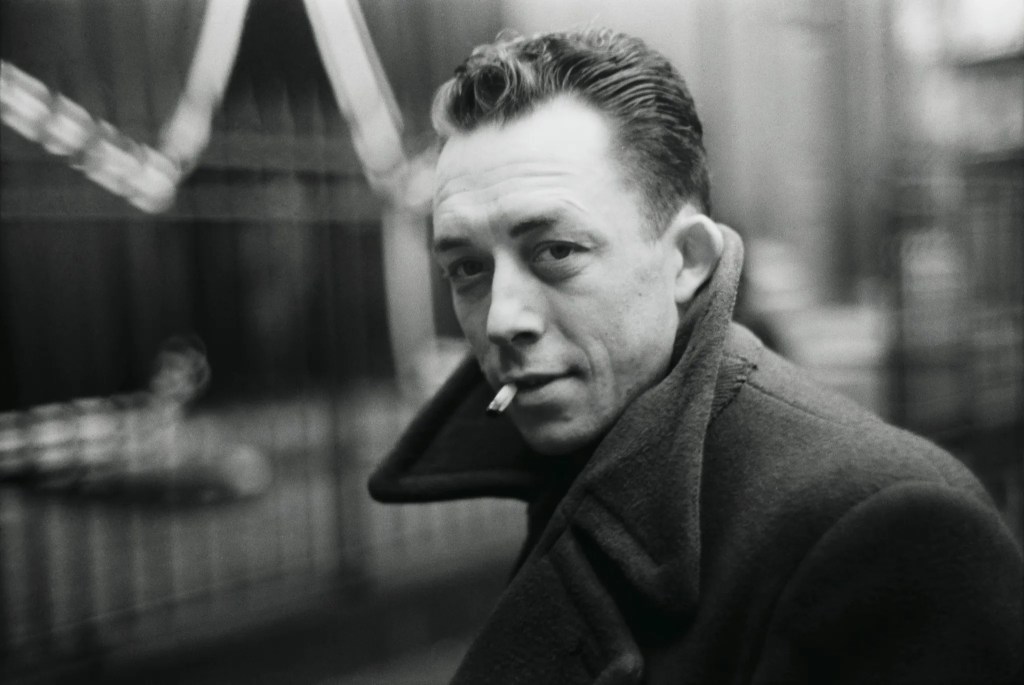
If God is dead and we cannot “receive” meaning from an external, traditional system of values, then we need to confront that. This is the starting point for both absurdism and existentialism. The absurd comes from the discrepancy between our desire for meaning and the Universe staying silent in the face of that desire. From this point onward, however, absurdism and existentialism diverge. The latter posits that we are responsible for creating our own meaning. Absurdism (for our use case, Albert Camus in “The Myth of Sisyphus”) does not believe that. It does not consider that we should even try to force meaning upon ourselves, as that would be similar to playing a childish game of pretend. Before giving the “solution”, however, Camus looks at two other possible responses. The first is religion. Camus considers it
a leap into transcendence
Religion tries to find meaning in God and thus avoids the absurd. The second possible response he looks at is suicide. Just like religion, suicide is nothing but avoiding the absurd. It is not solving anything, it is just an escape. Camus’s “solution” is that the absurd needs to be embraced. Life needs to be affirmed. The only thing that can be done in the face of the absurd is to live life fully in spite of it. This is why
one must imagine Sisyphus happy
 The Hermeneutic Herald
Leave a comment